
How to Choose Wall Art You Won't Get Bored Of ?
10 September 2026
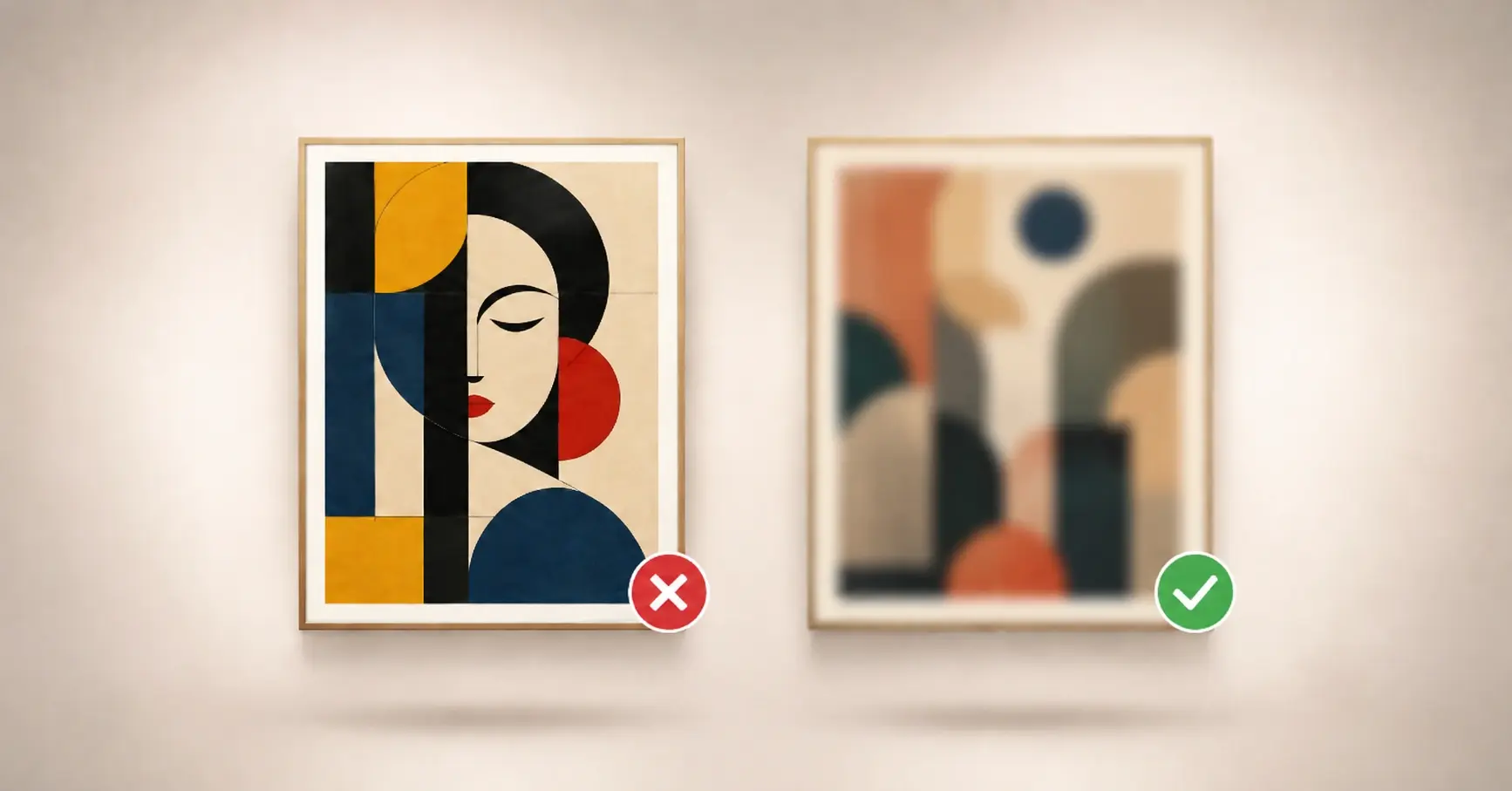
Your taste is going to change. That isn't a warning; it's just what happens.
The person furnishing a first flat at twenty-four isn't the person deciding what goes on the wall at thirty-two. You'll move through minimalism, or out of it. You'll find yourself drawn to colour you'd have called loud five years ago. You might discover folk art in your forties and wonder why nobody showed it to you sooner.
Which makes most advice about choosing timeless wall art slightly beside the point. Nobody can tell you what you'll always love. The useful question is narrower and much more answerable: is this a real response, or is this a mood?
Moods are convincing. They feel exactly like taste while you're in one. The difference only shows up later, when the mood has passed, and the artwork is still on the wall.
Here's how to tell them apart before you spend the money.
What a mood looks like from the inside
A mood is usually borrowed. You saw the style somewhere - a friend's flat, four listings in a row, a Pinterest board you were on for an hour- and the appeal has more to do with the context than the piece itself.
It's also fast. You liked it instantly and completely, with nothing left over. There was no moment of hang on, what's going on in that corner.
And it tends to be about surface. Ask someone in a mood why they like something, and you'll hear colour, or style, or vibe. All real answers. All the first things to wear out.
None of this makes a mood a bad reason to buy. Plenty of good purchases start as moods. It just means you shouldn't spend serious money on one without checking first.
What a lasting response looks like
Slower, and more specific.
You noticed a particular thing - the way one figure is turned slightly away from the rest, a colour that shouldn't work next to another one but does, a corner of the composition quieter than everything around it.
You came back to it. Not deliberately, on your own, days later, without meaning to.
And you probably can't fully explain the appeal. When you can list four clean reasons you like something, you're usually describing a decision made by the practical part of your brain - good at logistics, unreliable about what you'll care about later. The pull you can't quite account for is a different system responding, and it's the more accurate one.
Three tests worth running
Five days
Save the piece. Close the tab. Don't look at it again for five days.
Then come back and check what you actually remembered. Not did I like it - what specifically stayed with you?
If you remembered details, the response was real. If you only remembered a general good feeling, or had to reload the page to recall what it looked like, that was a mood. Cheap thing to find out now rather than after delivery.
Strip the room out
Imagine the piece somewhere completely wrong for it. Your parents' house. A rented flat with beige walls. A room containing none of your current furniture.
Do you still want it?
A lot of what feels like love for an artwork is actually love for the room you were picturing it in. Take the room away and see what's left.
Give it a minute
Look at it for a full sixty seconds - not the two seconds most art gets - and watch what your eye does after the first ten.
Still finding things at the second fifty? The piece has depth. Attention wandered at the second twelve? That's exactly how it'll behave on your wall.
This one matters more than the other two combined, and the next section explains why.
Depth is the whole mechanism
Think about how you relate to something you've lived with for years.
At first you see the obvious layer - colour, subject, overall feel. That layer wears out. It's meant to.
What replaces it depends entirely on whether there's anything underneath. In a piece with depth, you start noticing composition, then technique, then the choices someone made and didn't make. Eventually it stops being about the art and becomes tied to the years you spent looking at it.
In a piece without depth, nothing replaces the first layer. It goes quiet and becomes wall furniture - technically present, functionally invisible, like a light switch you stopped seeing years ago.
That's the real difference between art you outgrow and art that grows with you. Not style. Not price. Just how much is in there.
Two things that don't predict longevity
Neutrality. There's a persistent belief that muted, minimal, beige-adjacent work is the safe long-term bet. It isn't. A quiet piece with nothing behind it disappears just as fast as a loud one - it simply does it politely, so nobody notices they've stopped looking.
Matching. A piece chosen because it works with your current sofa has a deadline attached: the day the sofa goes. Coordination is a fine way to choose between two pieces you already want. It's a weak reason to want one in the first place.
Where your taste is likely to head
Worth thinking about, because you can sometimes buy slightly ahead of yourself.
Most people's taste moves in one direction over time - towards specificity. Broad, agreeable, goes-with-anything work early on. More particular, more personal, more culturally rooted later. People rarely travel the other way.
Which means a piece with a strong identity, bought before you were quite ready for it, tends to look better in five years rather than worse. The safe piece bought to fill a wall rarely becomes more interesting than it was on day one.
So if you're torn between something agreeable and something you're not sure about, the second one usually has the better odds.
Four pieces, four different ways of lasting
From the Kalakraft collection - useful less as recommendations than as illustrations of what longevity actually looks like.
Circle of Life in Warli Village lasts by inheritance. Folk forms have already survived several generations of changing taste, which is a considerably stronger track record than anything designed in the last decade.
Whispers Across the Lake lasts through mood rather than style. Atmosphere ages far more slowly than aesthetics - a piece that makes a room feel calm will still be doing that job when everything around it has changed twice.
Poise in Geometry lasts through adaptability. Balanced composition reads differently in a minimal room and a crowded one, and works in both, which matters when you don't know what your rooms will look like in a decade.
Ember Geometry lasts through commitment. It isn't trying to blend, and pieces that aren't trying to blend don't get quietly absorbed into the background the way agreeable ones do.
You're allowed to be wrong
One reassurance, because this can sound higher-stakes than it is.
If you buy something and go off it in two years, move it before you replace it. A piece that stopped working in the living room is often exactly right in a bedroom or hallway, seen at a different pace and in different light. Very little about hanging art is permanent, and rotating pieces between rooms costs nothing.
And a piece you loved for three years and then stopped loving hasn't failed. It did its job for three years.
The aim was never to buy something you'd feel identically about forever. It's to buy something with enough in it that your changing eye keeps finding new reasons to stop.
Run the five days, give it the minute, and back the piece you can't quite explain. Then have a look through the rest of the Kalakraft collection with the same test in hand.