
Madhubani Painting: Where It Comes From and How to Read It
24 September 2026
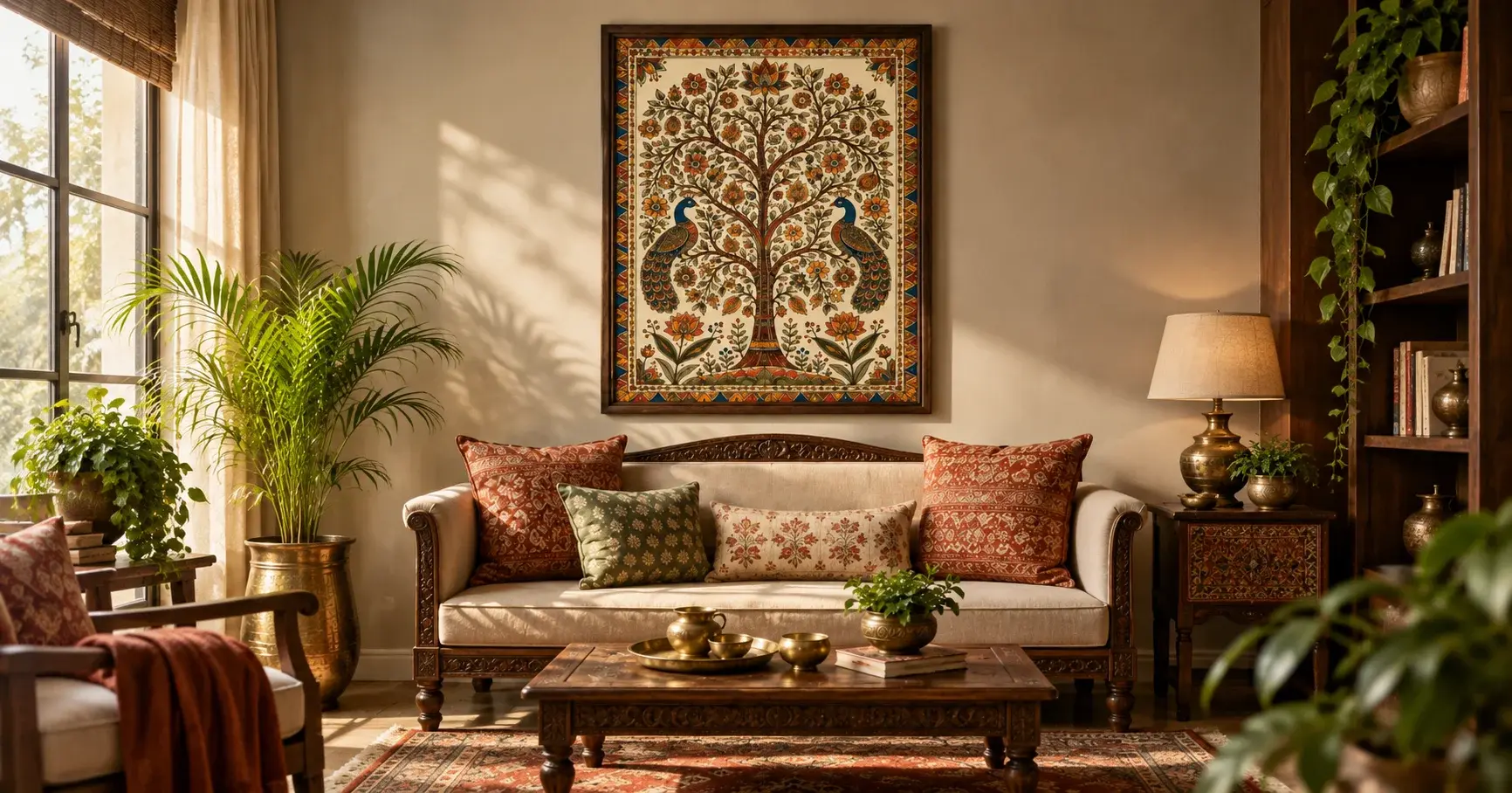
A Madhubani painting looks busy until you know what you're looking at. Then it stops being decoration and turns into a sentence.
Every fish in it means something. So does the peacock, the lotus, the bamboo, the way the border was drawn before anything inside it. This is a tradition where the density is the message, and once someone points that out, you can't look at one the same way again.
So this is the version written for someone who wants to hang one, rather than sit an exam on it.
Which state is Madhubani painting from?
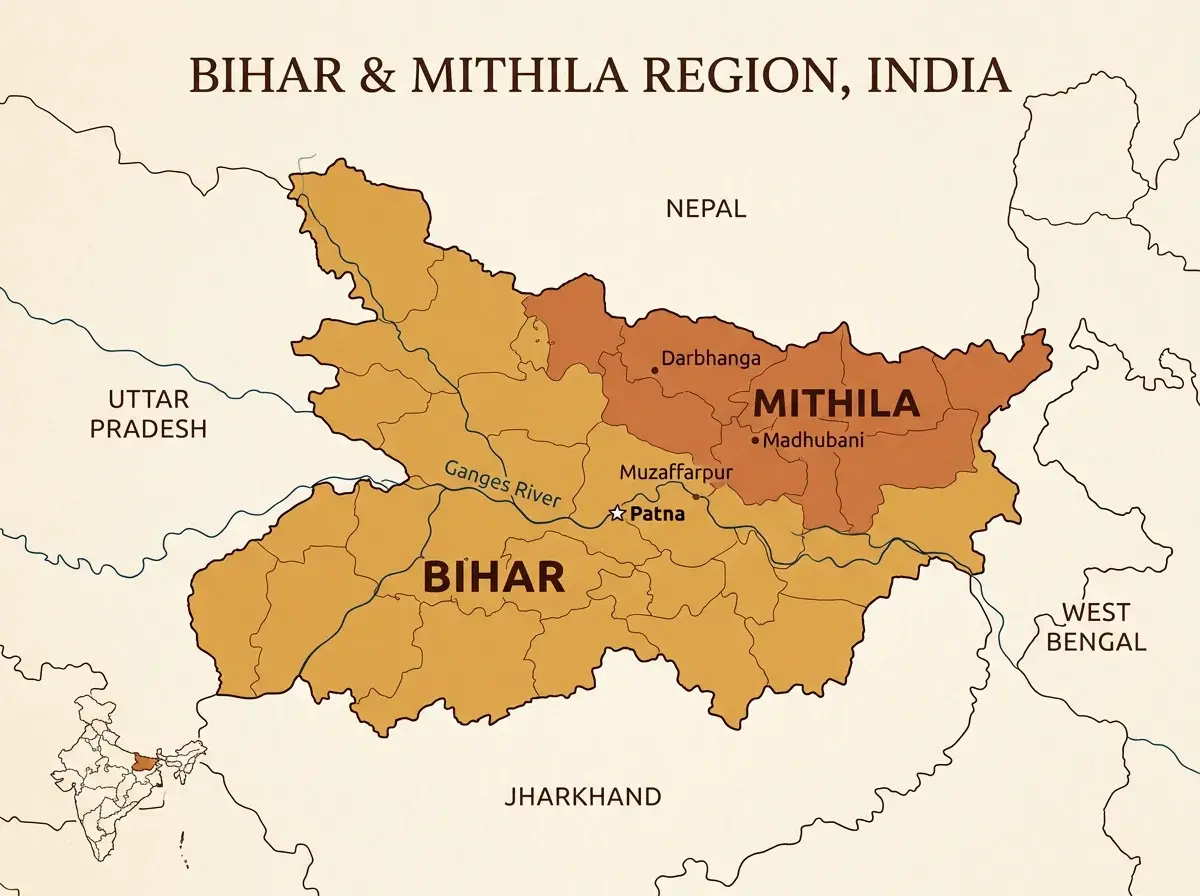
Bihar. Specifically the Mithila region in the north of the state, and the district of Madhubani, which is where the name comes from. Madhubani means forest of honey.
The tradition doesn't stop at the border, though. It carries on into the Nepali Terai around Janakpur, which is Sita's city in the Ramayana, and Mithila art is painted there too. That's why you'll sometimes see it called Mithila painting as well. The names are closely connected, though the terminology can vary depending on the context.
Inside Mithila, two villages come up more than any others: Jitwarpur and Ranti.
It started on walls, and it wasn't meant to last
For most of its history, this was not art you could buy. It was painted by women, on the freshly plastered mud walls and floors of their own houses, for weddings, for Chhath, for Saraswati Puja and Durga Puja. Then the wall was replastered, and the painting was gone.
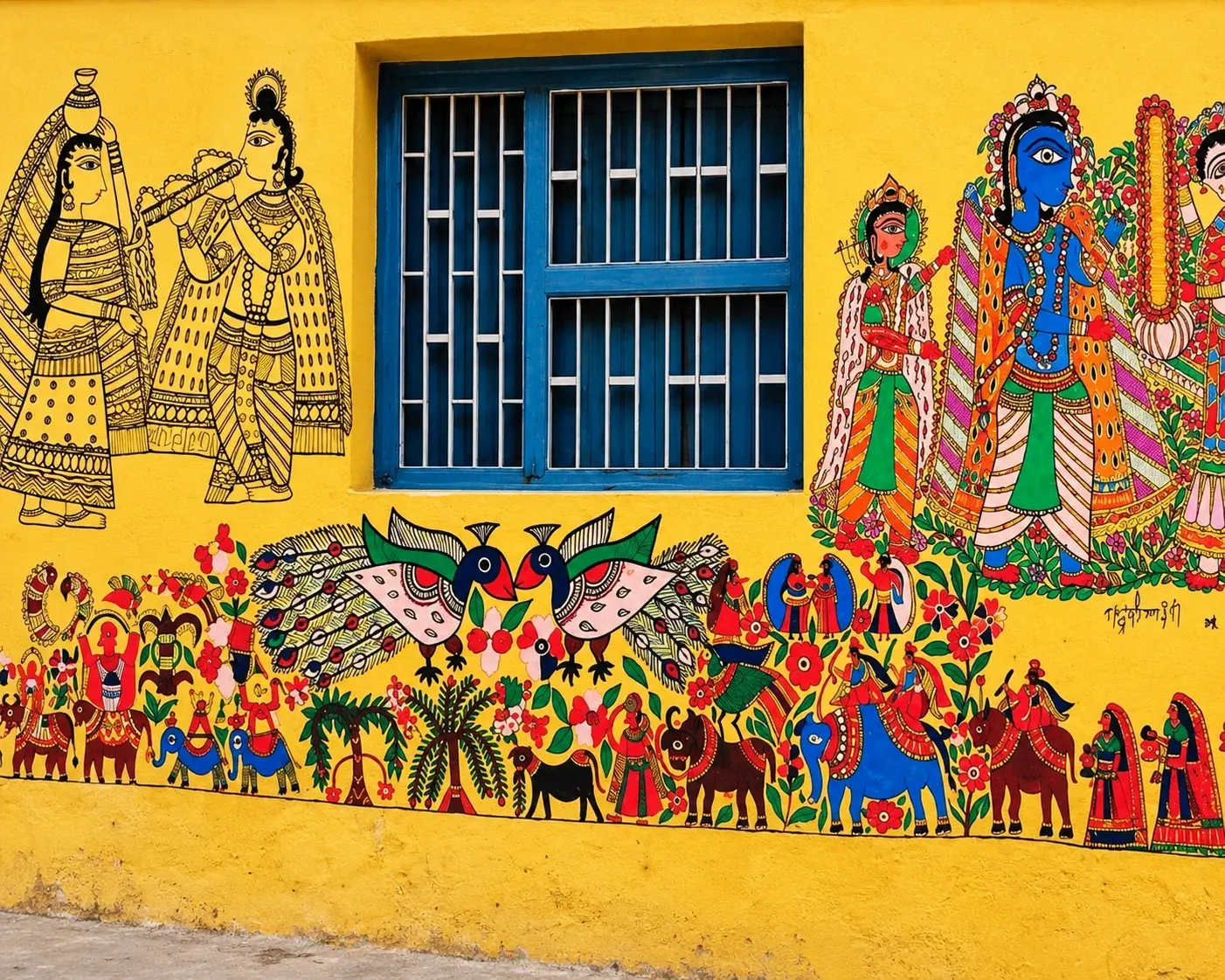
The most important version is the kohbar: the nuptial chamber, painted before a wedding for the couple's first nights together. No sketching, no corrections. What the women paint there is often a tree, heavy with flower and leaf until the ground beneath it disappears. It's the Kalpavriksha, the wishing tree, and the blessing is written into the density itself. May your life be so full that nothing in it stays blank.
There's a legend about the beginning too, which is worth knowing even though the history is thinner than the story. King Janaka of Mithila is said to have commissioned wall paintings for the wedding of his daughter Sita to Rama. Whether or not that's where it started, the link between this art and a marriage room has held for centuries.
Knowledge was traditionally passed from mother to daughter, within families and communities rather than through formal art schools. For a long time, the work remained closely connected to the region and its domestic rituals.
The earthquake that took it out of Mithila
On 15 January 1934, an enormous earthquake tore through north Bihar and Nepal.
William Archer, a British civil service officer posted in Madhubani the year before, was sent to survey the damage. Walking through houses that had been cracked open, he could see straight into inner rooms that outsiders would not normally have seen, and the walls were covered in painting. He photographed them and wrote about them later in Marg, in 1949, comparing what he'd found to Klee and Miró.
The bigger turn came with a drought. During the famine of 1966 to 67, the All India Handicrafts Board sent the artist Bhaskar Kulkarni into Mithila to persuade the women there to paint on handmade paper, so the work could be sold and bring in money.
That change, from wall to paper, is why you can own one. A private ritual became a livelihood, and an important example of rural women earning an income from their own craft. Sita Devi received the Padma Shri in 1981. In 2007, the name Madhubani painting was given a Geographical Indication tag.
Kachni, bharni and the rest
Five styles are usually recognised, and they're worth being able to tell apart, because they look quite different on a wall.
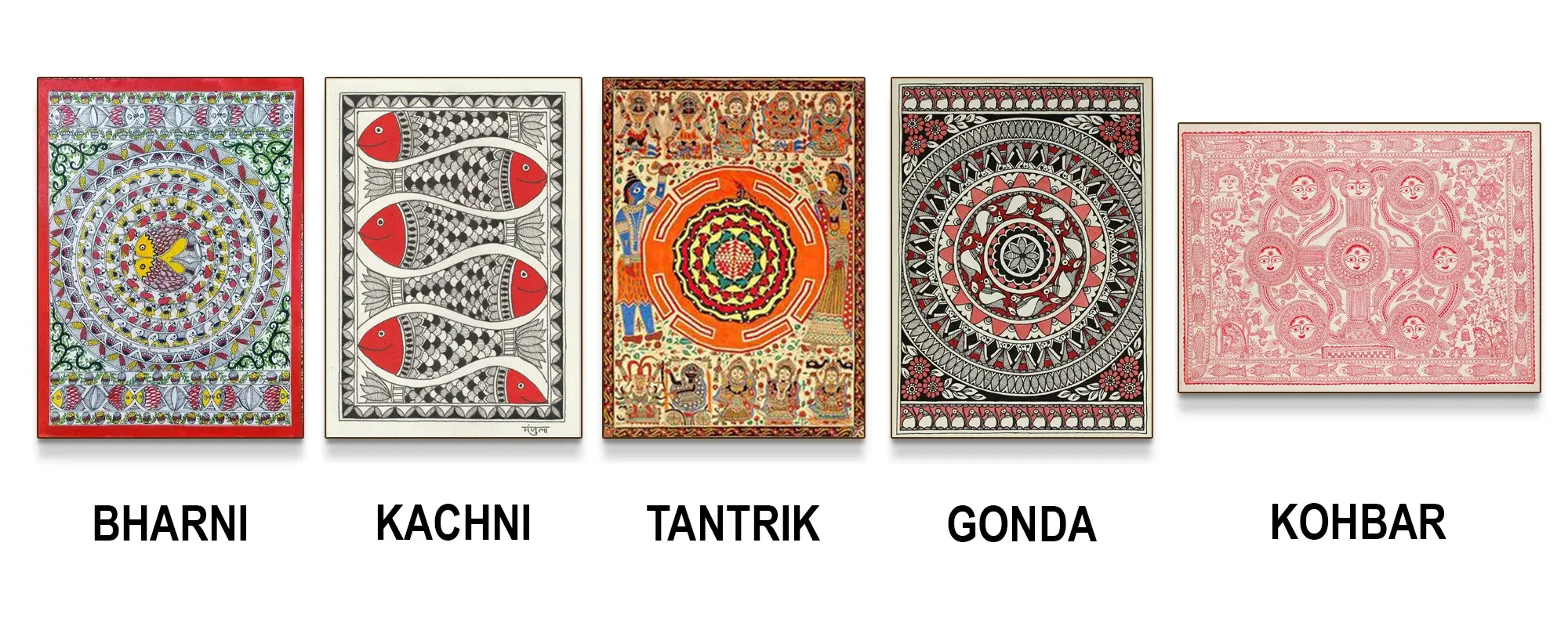
Bharni is the filled one: bold black outlines packed with flat, saturated colour. This is what most people picture when they hear Madhubani.
Kachni is the opposite. No colour blocks, or almost none — the whole image is carried by fine hatching and contour line, built up stroke by stroke. It's the more line-driven version of the craft.
Tantrik work depicts deities and ritual diagrams, drawn from religious texts.
Godna takes its patterns from tattoo traditions, and came into the paper tradition through the Dusadh community, whose repeating linear motifs are distinctive once you've seen them.
Kohbar is the wedding-chamber painting itself: lotus, bamboo, fish, the wishing tree, all of it about fertility and continuity.
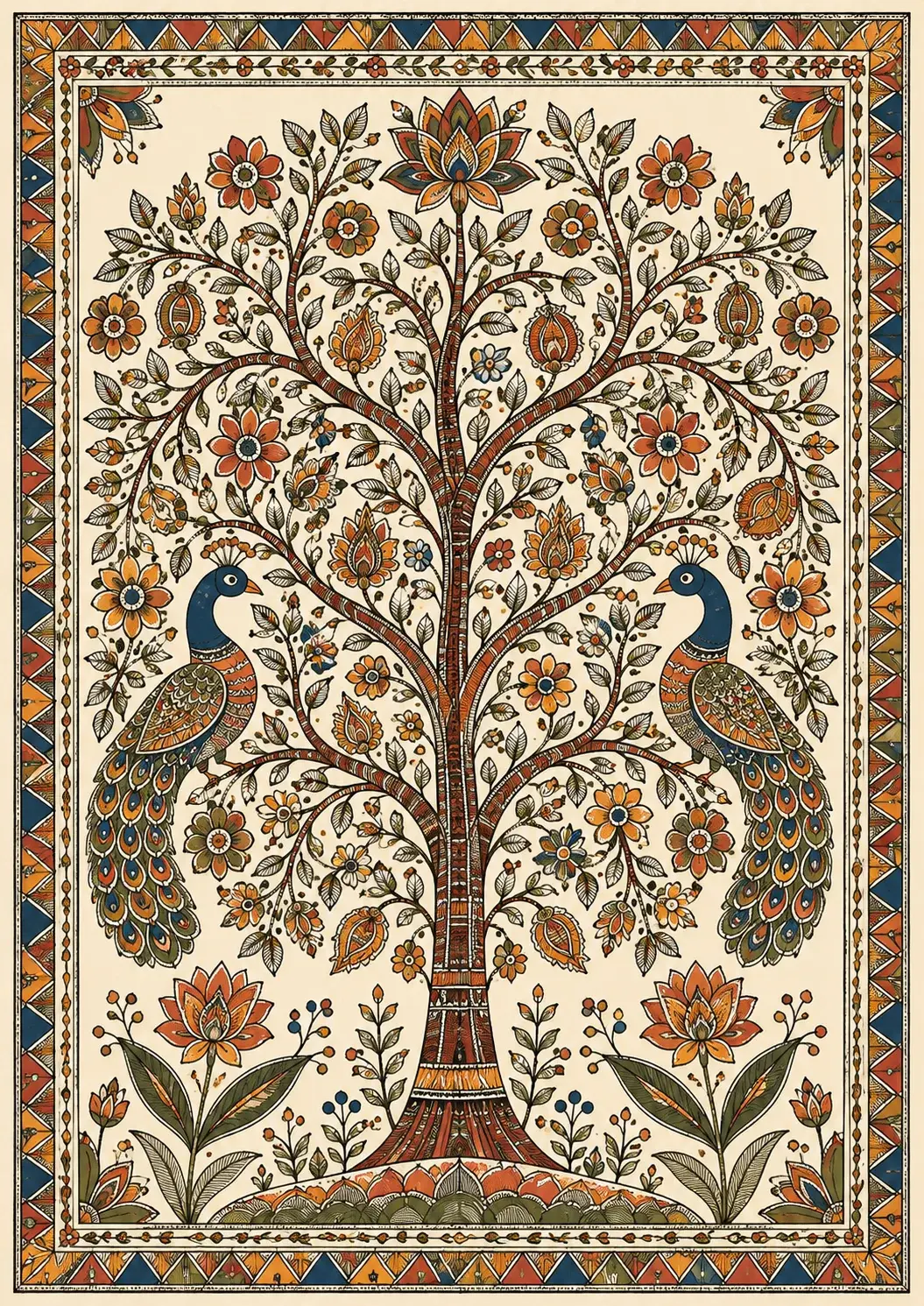
Our own Madhubani piece, Peacocks Beneath the Tree of Life, is kachni, and it's drawn from the kohbar tradition — a Kalpavriksha with two peacocks facing opposite ways beneath it and lotuses at the base. Lotus Pond Stories is the more colourful side of the tradition: a pond of blooming lotuses, birds, fish and lily pads in terracotta red, deep blue and leafy green.
How to read the motifs
Nothing in a Madhubani painting is filler. A short glossary gets you most of the way.
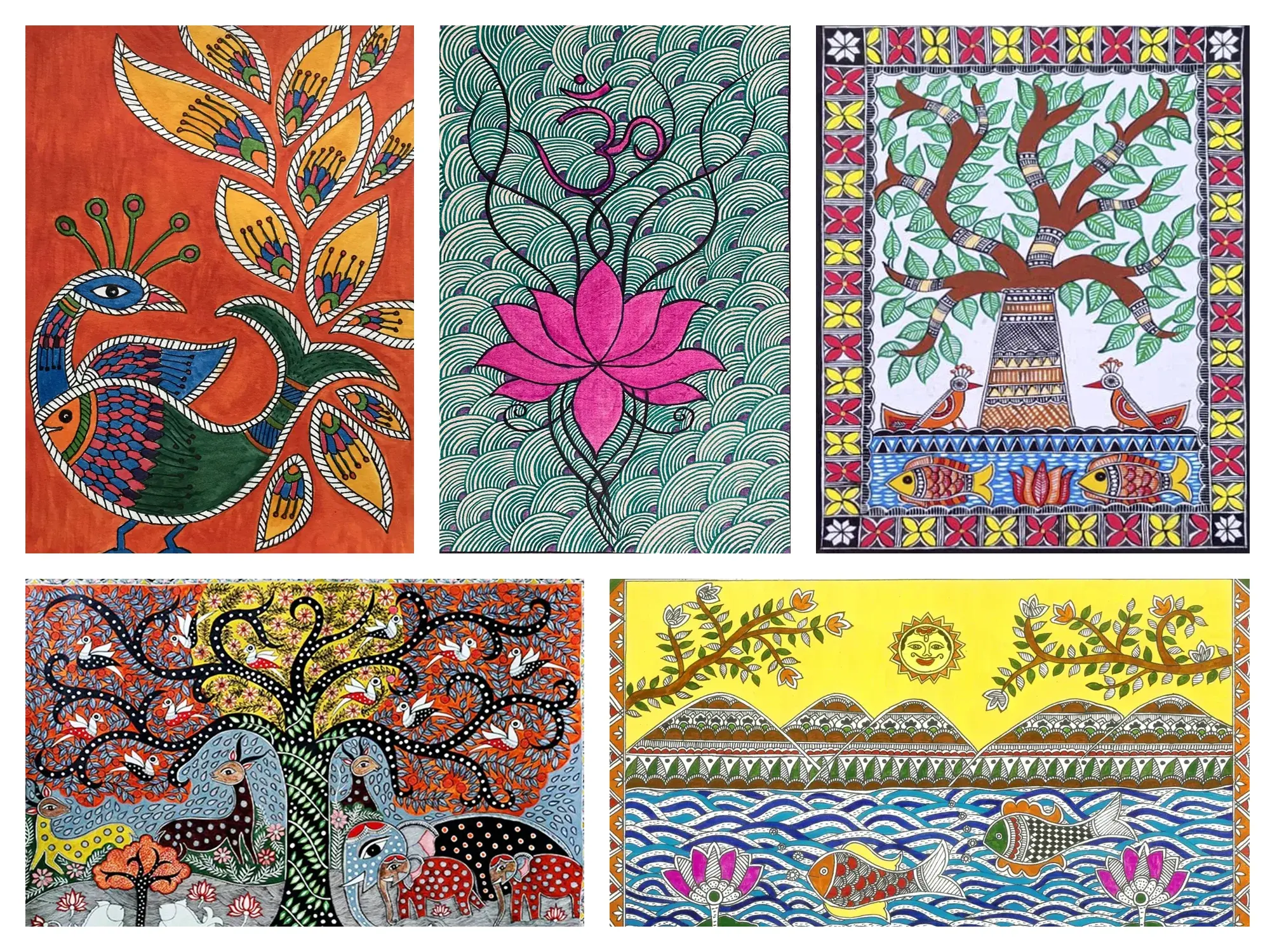
Fish are associated with fertility and good fortune, and they turn up constantly in kohbar work. The lotus rising out of water is associated with purity and the feminine principle. Bamboo stands for lineage and continuity, and the two are often painted together.
The peacock is associated with love and longing. That connection comes from the monsoon: the peacock dances when the first rain finally breaks a long summer, so it can suggest desire, anticipation and fulfilment. In kohbar paintings, the birds are often placed facing opposite ways, sharing one tree. Two people looking out at their own lives, held up by the same root.
The tree itself is the Kalpavriksha, associated with growth, shelter and the connection between everything under it. Sun and moon suggest permanence. Snakes are associated with protection. Parrots can represent messages between lovers. Elephants suggest strength.
Two other habits are worth noticing. Empty space gets filled — with flowers, birds, geometric marks, whatever fits — creating the dense visual quality that is so characteristic of the tradition. And the border goes on first. Before any of the life inside it, the boundary gets drawn.
How to Tell Quality Madhubani Work
This is the part that actually matters when you're choosing, and almost nobody writes about it.
Find the densest thing in the composition. In a peacock piece, that's often the tail. Zoom in as far as the image lets you, and look at the eyes of the feathers. Are they each drawn separately, one stroke at a time? Or does the same shape appear repeatedly across the tail?
Do the same with leaves. Look at how the veins and internal details have been handled. In detailed Madhubani work, these small marks contribute to the overall rhythm of the painting rather than simply filling space.
Then look at the line itself. Kachni hatching is built stroke by stroke, so slight variations can be part of the character of handmade work. Perfectly uniform, mechanical-looking lines may indicate a reproduction or a digitally constructed pattern rather than the appearance of hand-drawn line work. Check the border too: is it patterned and considered, or does it look like a frame added as an afterthought?
Last, the colour. Traditional palettes have historically drawn from available natural materials, including soot and lampblack, turmeric, indigo, plant extracts and minerals, applied with tools such as bamboo twigs, matchsticks and nib pens. This is one reason traditional Madhubani palettes often include ochre, earth red, indigo and olive tones.
Original, print, and what the GI tag actually protects
Worth being straight about this, because the labelling in this market can be confusing.
The Madhubani painting tradition has a Geographical Indication registration dating from 2007. If you're buying a handmade work described as an authentic Madhubani painting, it's worth checking the artist, place of production and seller information rather than relying on the name alone.
So if what you want is a handmade original, look for Mithila artists, cooperatives or galleries that clearly identify the artist and the work. That gives you a much clearer idea of what you're buying and where the work comes from.
What we sell is prints. Peacocks Beneath the Tree of Life and Lotus Pond Stories are artwork in the Madhubani tradition, reproduced as prints on paper or canvas, and we'd rather say that plainly than dress it up.
A print gets you the composition, the symbolism and the line work on your wall at a scale most households can actually manage. It isn't a handmade original, and it shouldn't be presented as one.
If a listing anywhere is vague about which of the two you're buying, that's worth a question before you pay. Our guide to comparing art print quality covers what else to ask.
Madhubani painting in a modern living room
The assumption that folk art needs a traditional room is backwards. Madhubani can work especially well against a simple, contemporary background.
Give it a quiet wall. Off-white, pale grey and beige allow the detailed artwork to stand out without competing with it. Wood can work particularly well too - a teak or oak frame, a cane chair or a jute rug can complement the natural feel of the artwork.
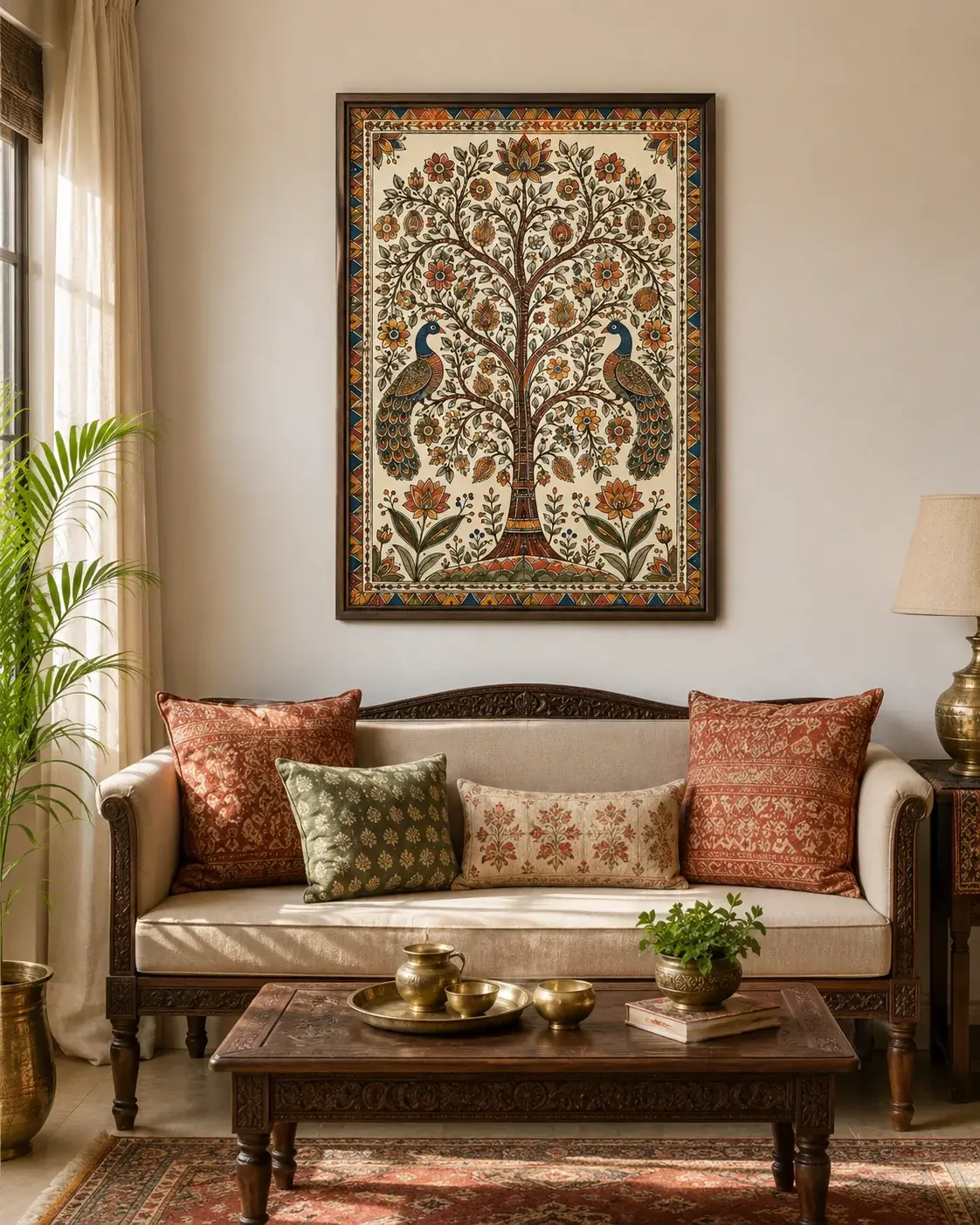
Because Madhubani is visually dense, one well-placed piece can often make more impact than several competing pieces on the same wall. If you want more folk art in the room, let one Madhubani piece lead and put a quieter piece on a different wall.
Light it warm if possible. Warm lighting can bring out the earthy tones in the artwork, while very cool lighting can make those colours appear flatter.
On height and size, the usual rules: centre it around 145 to 150 cm from the floor, or 15 to 25 cm above the furniture below. A detailed piece like this rewards being hung where people pass close to it, such as a hallway or beside a doorway, because the line work is easier to appreciate up close. The wall art size guide has the measurements.
And if you're placing it by Vastu, a peacock piece is usually recommended for the north, north-east or east wall. There's more in our post on peacock painting Vastu.
Where to start
If you like line work, start with the kachni peacocks. If you want colour and a busier scene, Lotus Pond Stories. Both come from the same tradition and behave completely differently on a wall.
And if this is the tradition you're drawn to, go and look at the real thing properly at some point. The Mithila Art Institute in Madhubani, the Bihar Museum in Patna, and exhibitions where the artists are named and present can give you a much better sense of what you're looking at. A print on your wall is a good reason to go and see what it came from.
More folk work is in the folk art prints collection, and our post on Indian folk art for modern homes covers how Warli, Gond and Pattachitra differ from this.