
Sohrai and Khovar: The Story Behind Jharkhand's Living Wall Art
8 September 2026
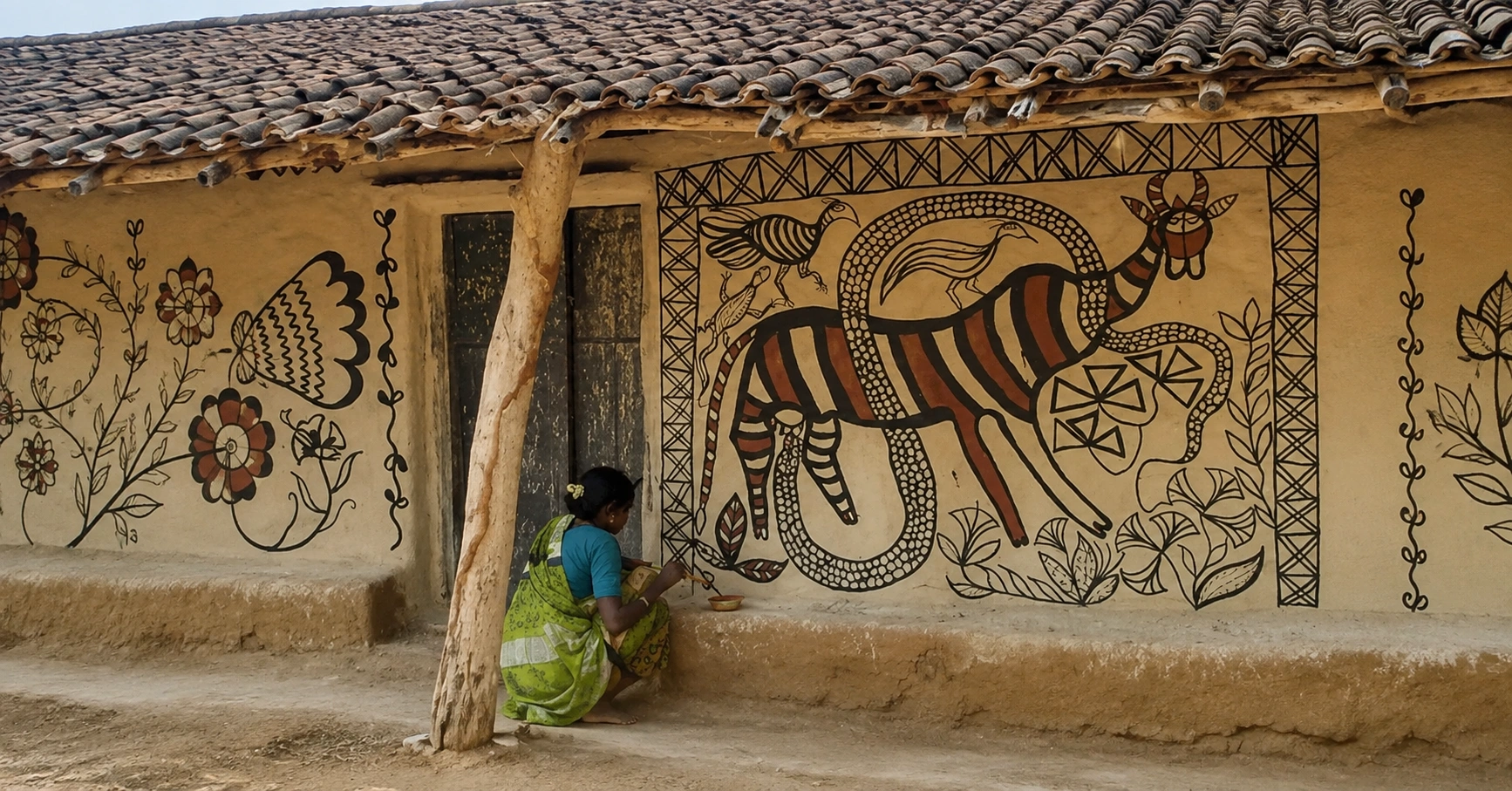
There's a category of Indian art that most people have never heard of, and it isn't in a gallery. It's on the outside of houses in Hazaribagh, a few hours from where we work in Ranchi, and it gets painted over and remade on a schedule set by the harvest and by weddings.
Animals, birds, trees, flowing lines and geometric forms cover mud-plastered walls. The work is done by women, using knowledge passed from mother to daughter, in earth colours dug from the ground nearby.
These are Sohrai and Khovar - two distinct traditions, often mentioned together and frequently confused with each other.
Their visual language has started appearing in contemporary art and home decor, which is broadly a good thing. But a motif lifted onto canvas without its story is just a pattern. The interesting part is where it came from and what it was for.
First, they're not the same thing
The two names appear side by side so often that they're usually taken for variations of one style. They're closer to cousins - same visual vocabulary, same painters, different reasons for picking up a brush
Sohrai is harvest art. It's tied to the agricultural cycle and to cattle - the Sohrai festival honours cattle and their welfare, and is traditionally observed around the new moon following Diwali, at the close of the harvest. The paintings go up in that season.
Khovar is marriage art. It's connected to weddings and to a bride entering her new home. The work appears on the walls of the house for that occasion, marking a beginning rather than a harvest.
So the same village, the same painters, the same broad visual vocabulary - but two different moments in the year and two different reasons for the wall to be repainted.
Understanding that distinction changes how you read the work. A Sohrai wall is about abundance, animals and the year that's just been survived. A Khovar wall is about a new relationship and a new household.
Where Jharkhand sits in India's folk art map
India's folk traditions are often grouped, which makes it easy to miss how distinct they actually are.
Madhubani comes from Mithila in Bihar. Gond art belongs to the Gond community, with deep roots in Madhya Pradesh. Pattachitra is associated with Odisha and Bengal. Warli belongs to Maharashtra.
Sohrai and Khovar belong to Jharkhand, with particularly strong roots around Hazaribagh.
These traditions share some surface characteristics - nature, animals, symbolic forms, storytelling - which is why they get grouped. But sharing subject matter isn't the same as sharing an identity. A Warli composition and a Sohrai wall look different, mean different things, and come from different communities several hundred kilometres apart.
Regional identity isn't incidental to this work. It's a substantial part of what the work is.
What the walls actually look like
The most immediate thing about Sohrai and Khovar is that nature isn't used as decoration. It's the vocabulary itself.
Cattle appear constantly, which follows directly from what Sohrai celebrates. So do birds, trees, leaves, flowers and fertility motifs. But they rarely sit as isolated subjects on a plain background the way an animal might in a European still life.
Instead, the forms interlock. Animals become part of a repeating pattern. Plants turn into borders. A line that starts as a branch becomes something else by the time it reaches the edge. The wall isn't a backdrop the painting sits on - the wall is part of the composition, and the shape of the house dictates the shape of the work.
That's why photographs of Sohrai and Khovar often look busier than the walls do in person. On a real house, the doorways, corners and roofline give the pattern somewhere to breathe.
The other thing you notice is how much is achieved with very little.
The colours come out of the ground
Traditional Sohrai and Khovar work uses earth pigments - red oxide and red ochre, kaolin white, manganese black among them. Materials from the surrounding land rather than from a shop.
This gives the work its particular character: warm, matte, slightly variable, unmistakably of a place. Two houses in the same village might not have quite the same red, because the earth wasn't quite the same.
It also imposes a discipline that turns out to be a strength. With a small palette, the impact has to come from contrast and from form. Dark against light. Red against white. Dense pattern against open space.
There's a lesson in that which extends well past this particular tradition. Expressive work doesn't need dozens of colours. A restricted palette, used with confidence, produces a stronger identity than a wide one used carelessly - something worth remembering when you're choosing art for your own walls.
The women who carry it
The part of this story that gets the least attention is who has actually kept these traditions alive.
Sohrai and Khovar have historically been practised by women, with the knowledge handed down through the female members of families and communities. Not taught formally. Learned by watching, by helping, and eventually by doing.
That makes the work a form of transmitted knowledge as much as a visual style. The motifs, the proportions, the sense of when a wall is finished - none of it exists in a manual. It exists in the people who paint it, and it survives only as long as it keeps being passed on.
It's also worth sitting with what that means practically. This is art made by people who were not, for most of its history, called artists. It was made in their own houses, for their own occasions, with no market attached and no audience beyond the village.
Art that was never meant to last
Here's the thing that separates Sohrai and Khovar from almost everything hanging in a gallery.
It was painted on mud. Exposed to weather. Made to be repainted.
A Sohrai wall isn't a permanent object. It belongs to a season, and the next season gets its own. Khovar belongs to a wedding, and a different wedding will want a different wall.
This is nearly the opposite of how we treat art now - as a fixed object, bought once, preserved, insured, hung for decades. These traditions treat painting as something you do, recurring, tied to time, rather than something you own.
Which raises an obvious question about what happens when the work moves onto paper.
From mud walls to canvas
The visual language of regional Indian art is increasingly being adapted to paper, canvas and print. That transition genuinely helps - it brings income to artists, and it carries traditions to people who'd otherwise never encounter them.
But something changes in the move, and it's worth being honest about it rather than pretending otherwise.
A Sohrai motif on canvas is no longer seasonal. It doesn't get painted over. It's separated from the house it belonged to and the occasion it marked. What was an activity becomes an object.
That isn't a reason to avoid it. Traditions that refuse to move don't usually survive. But it does place a responsibility on everyone in the chain - artists, sellers, buyers- to keep the story attached to the pattern.
A motif with its history stripped out is decoration. The same motif with its context intact is something considerably more interesting.
Why this kind of work sits well in a modern home
A contemporary Indian home tends towards clean lines, neutral walls, restrained furniture. There's a common assumption that folk art fights with that.
It doesn't, generally. It does the opposite - the contrast is exactly what makes both things visible. Earth-toned, hand-made, pattern-dense work in a minimal room reads as deliberate. The same piece in an already-busy room disappears.
The deeper reason it works is that this art brings something most decor can't: a sense of place. Not a style borrowed from a moodboard, but an actual location, community and set of practices behind the image.
Which shifts the question you ask while choosing. Instead of does this match my room, you get to ask what does this bring into the room - and a piece with a real story behind it will still be answering that question in ten years, long after the trend cycle has moved on.
Where Kalakraft stands on this
Worth being straightforward: the Kalakraft collection doesn't currently include Sohrai or Khovar work. We're writing about it because it belongs to the state we work in and deserves more attention than it gets, not to sell you something at the end of it.
What we do carry is work rooted in other Indian traditions - pieces like Circle of Life in Warli Village and Birdsong in the Tree of Life, which draw on Warli's visual world and the tree-of-life motif that recurs across several regional traditions.
Those are Maharashtrian in origin, not Jharkhandi, and after everything above it would be odd to blur that. Different traditions, different communities, different meanings. The point of learning about one is not to make the others interchangeable - it's to notice how differently each region chose to represent nature, community and celebration.
The art was home before it was art
Sohrai and Khovar are a reminder that some of India's strongest visual traditions never passed through a gallery.
They started on houses. During harvests and weddings. Made with earth from nearby, by women whose names were mostly never recorded, using knowledge that existed only in the practice of it.
Their influence now reaches well beyond Hazaribagh, which is a good outcome. But the meaningful way to appreciate them is to know what you're looking at - that the cattle mean something, that the season matters, that a Khovar wall is marking a specific day in a specific family's life.
Understand that, and you're not looking at a pattern. You're looking at a piece of living culture that happens to be beautiful.