
How to Choose the Right Wall Art Size for Your Space
16 August 2026
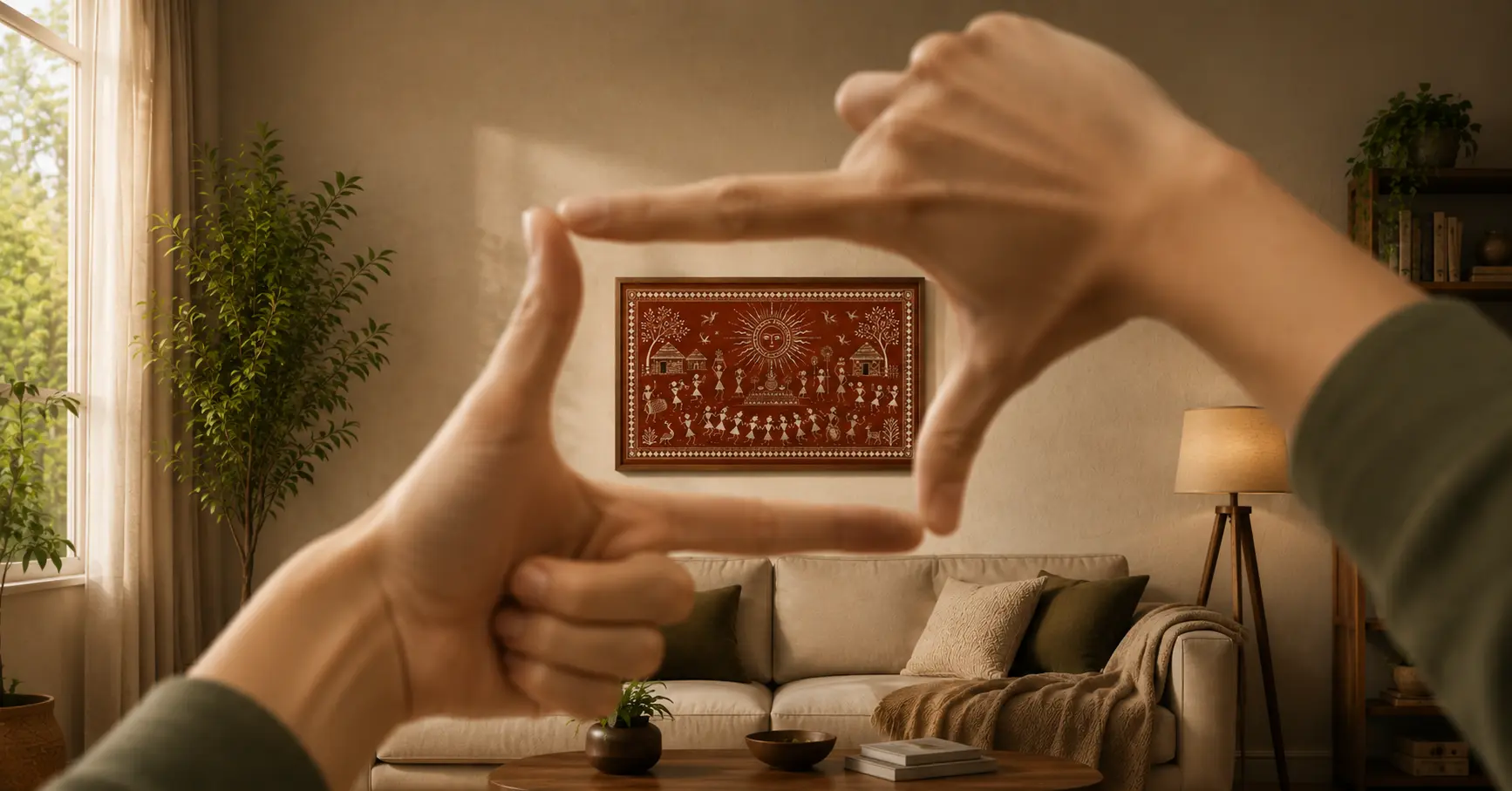
Choosing wall art is not only about finding a design you love. Size matters just as much. An artwork that is too small can disappear on a large wall, while something too large can make a room feel crowded.
The good news is that choosing the right size doesn't have to be complicated. Your wall dimensions, furniture, room size, and available space can help you make the right choice.
Start with the sizes you can actually buy
Most of the sizing advice online assumes you're buying a single large canvas. Kalakraft prints come in A5, A4 and A3, with a few pieces in 8 × 10, 12 × 15, 16 × 20 and 12 × 20 inches, and the paper prints are supplied for you to frame. So the number that matters on your wall is the framed size, not the print size. A frame with a 5 cm mount adds roughly 13 cm to each dimension.
Print Size | Print (cm) | Roughly, framed with a mount |
|---|---|---|
A5 | 14.8 × 21 | 28 × 34 cm |
A4 | 21 × 29.7 | 34 × 43 cm |
A3 | 29.7 × 42 | 43 × 55 cm |
8 × 10 in | 20 × 25 | 33 × 38 cm |
12 × 15 in | 30 × 38 | 43 × 51 cm |
16 × 20 in | 41 × 51 | 54 × 64 cm |
12 × 20 in | 30 × 51 | 43 × 64 cm |
Everything below uses the framed numbers. If you frame without a mount, or with a wider one, adjust accordingly.
How to Choose Wall Art Size for a Living Room
The wall above a sofa is one of the most common places for wall art in a living room.
A useful starting point is an arrangement around two-thirds to three-quarters of the sofa's width, which creates a visual connection without the art feeling lost or oversized. A 3-seater sofa in most Indian homes is 180 to 210 cm wide, so you're aiming for something 120 to 155 cm across. No single print gets there, and it doesn't need to.
A triptych of A3 prints framed portrait comes to roughly 145 cm wide with 8 cm gaps between the frames, which is exactly right for a 200 cm sofa. Happy Shapes – Dopamine Abstract Triptych, Quiet Horizon – Abstract Landscape Triptych Set and Desert Balance are all sold as sets for this reason. The same three frames hung landscape stretch to about 180 cm, which suits a large L-shaped sofa rather than a standard three-seater.
For a two-seater of 140 to 160 cm, a pair of A3 prints framed landscape gives about 118 cm, or three A4 prints framed portrait about 114 cm. A single 16 × 20 print, such as Golden Axis – Geometric Harmony, frames up to roughly 54 × 64 cm, which is right for the wall above an armchair or a console, not a sofa.
Hang the bottom edge of the frames 15 to 20 cm above the sofa back so the art reads as part of the seating, not something floating above it.
What Size Wall Art Works Above a Bed?
The same proportion applies, measured against the bed rather than the sofa. A queen bed is 152 cm wide, so you're looking for 100 to 115 cm of art: a pair of A3 prints framed landscape (about 118 cm) or three A4 prints framed portrait (about 114 cm). Quiet Botanicals is sold as a pair for exactly this wall.
A king bed at 183 cm wants 120 to 140 cm, which is the A3 portrait triptych again, or a pair of 16 × 20 prints. A single bed of 90 to 100 cm takes one A3 print framed portrait, or a vertical piece like Eternal Union – Radha Krishna in Bloom, which comes in 12 × 20 and frames to roughly 43 × 64 cm.
Keep the bottom of the frame 15 to 25 cm above the headboard, and in a small bedroom leave the side walls alone; one arrangement above the bed and nothing competing with it keeps the room calm.
How to Choose Art for a Large Empty Wall
Large walls can easily make small artwork look lost, so size matters most when decorating a wide or empty wall.
If you have a wide empty wall, consider:
One large statement artwork
A horizontal composition
A triptych set
Two or more coordinated art pieces
Triptych sets are the first answer because three panels create width without one oversized print: Tropical Bloom Symphony – Triptych Set or Tropical Garden Blooms – Floral Triptych Set, framed landscape cover about 180 cm.
The second answer is a grid. Six A4 prints in two rows of three, framed portrait with 6 cm gaps, cover roughly 114 × 92 cm and hold a 3 m wall on their own.
The five botanical studies in the collection- Scarlet Hibiscus Study, Silent Leaf Study, Lotus in Bloom, Violet Cineraria Bloom and Whispers in Bloom- make a ready grid, and a row of Circle of Life in Warli Village, River of Life and Peacocks Beneath the Tree of Life in A3 does the same for a folk wall.
Our guide to wall art ideas for empty walls covers the layouts.
What About Small Walls?
A small wall doesn't necessarily mean you need the smallest artwork available.
One well-proportioned art piece can actually look more intentional than several tiny pieces, which is why choosing the right wall art size matters even in smaller spaces.
For smaller spaces, consider:
Small or medium-sized artwork
Vertical compositions
One statement piece
A compact gallery arrangement
Most importantly, leave some space around the artwork. It helps the piece stand out instead of making the wall feel crowded. A5 and A4 are made for these spots: the wall beside a kitchen door, the niche by an entrance, the return wall on a staircase. One A4 in a slim frame, something like Trumpet Bloom Hummingbird or Poise in Geometry, with 10 cm of clear wall on each side, looks more deliberate than three small things jostling.
How the Shape of Your Wall Affects Your Choice
The shape of your wall can help determine the orientation of your artwork.
Wide wall:
Horizontal artwork, triptych sets, or multiple pieces in a row.
Narrow wall:
Vertical artwork or a single medium-sized piece.
Square wall:
Square artwork, balanced pairs, or a compact arrangement.
These aren't strict rules, but matching the proportions of the artwork to the wall usually creates a more harmonious result.
How high to hang it
Size goes wrong more often through height than width. The centre of the artwork, or of the whole arrangement, should sit about 145 to 150 cm from the floor, roughly eye level for a standing adult. Above furniture, the furniture wins: 15 to 20 cm above a sofa back, 15 to 25 cm above a headboard, whatever that does to the centre line.
Gaps between frames: 5 to 8 cm in a grid, 8 to 10 cm between triptych panels. Wider than that and the set stops reading as one piece.
Common Wall Art Size Mistakes
Choosing Something Too Small
A tiny artwork can get lost on a large empty wall.
Ignoring Furniture Width
Artwork placed above a sofa or bed should generally relate to the width of the furniture underneath it.
Filling Every Empty Wall
Not every blank wall needs decoration. Empty space can actually help your existing artwork stand out.
Buying Before Measuring
This is the easiest mistake to avoid.
Sizing the Print Instead of the Frame
An A3 print is 29.7 × 42 cm. Framed with a mount, it's closer to 43 × 55 cm. Measure your wall against the second number.
Hanging Too High
The most common mistake in Indian living rooms. Art hung near the ceiling reads as filler; bring the centre down to eye level.
Measure the wall first, then choose your artwork.
A Simple Wall Art Size Guide
If you're unsure about the right wall art size, use these measurements as practical starting points:
3-seater sofa (180–210 cm): triptych of A3, framed portrait, about 145 cm
2-seater sofa (140–160 cm): pair of A3 framed landscapes, about 118 cm
Queen bed (152 cm): pair of A3 landscape or three A4 portrait, 114–118 cm
King bed (183 cm): triptych of A3 portraits, or a pair of 16 × 20
Single bed (90–100 cm): one A3 portrait, or one 12 × 20
Large empty wall (3 m+): a landscape triptych, about 180 cm, or a 2 × 3 grid of A4
Console or armchair: one 16 × 20 or one A3
Small wall or niche: one A4 or A5 with 10 cm of clear wall around it
Centre height: 145–150 cm from the floor; frame gaps 5–10 cm
These are guidelines rather than strict rules. Your room's proportions and personal style should always have the final say.
Find the Right Wall Art for Your Space
The right artwork isn't necessarily the biggest or smallest piece you can find. It's the one that feels balanced within the space around it.
Every piece in the Kalakraft collection lists its available print sizes on the product page, and the triptych sets are grouped in their own collection so you can pick by wall width first.
Before choosing, measure your wall, consider the furniture around it, and decide how much visual attention you want the artwork to have.
A little planning can make a big difference.
The goal is simple: choose artwork that fits your wall-not artwork that simply fills it.